
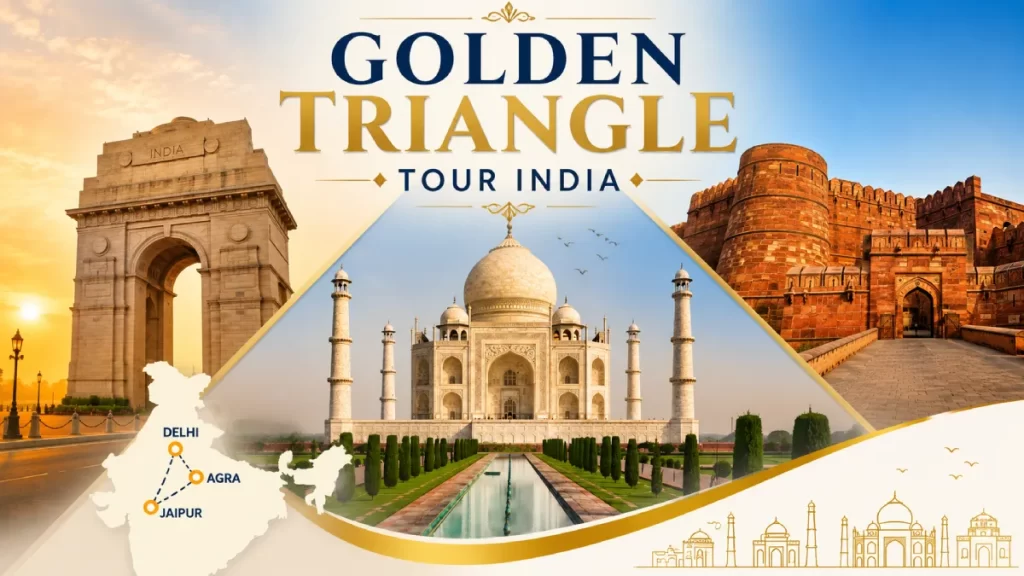
If you’re planning your first trip to India and only have about a week, the Golden Triangle– Delhi, Agra, and Jaipur- is the classic starting point, and for good reason. Each city brings something distinct: Delhi’s layered history, Agra’s Mughal architecture, and Jaipur’s royal Rajasthani heritage. Here’s a Golden Triangle Tour Itinerary simple breakdown of how the trip comes together, plus a few practical notes on getting around comfortably.
Day 1–2: Delhi
Start in Delhi to ease into the trip. Old Delhi’s Red Fort and Jama Masjid offer a dense, atmospheric introduction to Mughal history, while New Delhi’s India Gate and Humayun’s Tomb (often called a precursor to the Taj Mahal’s design) round out the historical picture. A day exploring local markets and street food is practically mandatory before heading out of the city.
Local tip: Delhi’s traffic and distances between sights (Old Delhi to South Delhi can take 45+ minutes) make a private car genuinely useful even within the city, not just for the intercity leg. If you’re arriving at Indira Gandhi International Airport, arranging an airport pickup with Urbania Rental Services ahead of time means you skip the prepaid-taxi queue and start sightseeing sooner.
Day 3: Agra
This is the day most people build the entire trip around. The Taj Mahal, ideally visited at sunrise for the best light and smallest crowds, anchors the day, followed by Agra Fort in the afternoon. If your schedule allows an extra half-day, Fatehpur Sikri- the abandoned Mughal capital just outside Agra adds a fascinating, less-crowded historical layer.
Delhi to Agra is roughly a 3–4 hour drive depending on traffic and route, and it’s the leg travelers most want done in a well-maintained, air-conditioned vehicle rather than a shared option- the Yamuna Expressway can be a long, uncomfortable stretch in the wrong car.
Day 4–5: Jaipur
The “Pink City” brings a completely different flavor to the trip. Amber Fort, best explored in the morning before the heat sets in, is the highlight for most visitors, while City Palace and Hawa Mahal fill out the rest of the sightseeing. Jaipur’s bazaars- Johari Bazaar for jewelry, Bapu Bazaar for textiles are worth a slow afternoon browsing rather than a rushed visit.
Getting Between Cities: Why a Private Vehicle Makes the Difference
Most travelers doing this circuit for the first time opt for a private vehicle covering the entire route rather than juggling trains or flights between each city. It removes the logistical headache of navigating unfamiliar transport systems and allows flexible stops along the way- useful for photo breaks or roadside food stalls that end up being unexpected trip highlights.
This is where Urbania Van Rental Services in Delhi fits naturally into the plan. Rather than booking separate transfers city-to-city, most first-timers book one vehicle for the entire Delhi–Agra–Jaipur loop, which means:
- One driver, one vehicle, the whole trip– No re-booking or re-briefing a new driver at each stop
- Flexible stops– For photo breaks, roadside dhabas, or an unplanned detour to Fatehpur Sikri
- Fixed, upfront pricing– For the full circuit instead of negotiating fares city by city
- Comfortable, well-maintained cars– Suited to long highway stretches like the Delhi–Agra and Agra–Jaipur drives
- A driver who knows the route– Arguably the single most valuable thing on this trip, since route familiarity affects everything from timing to which stops are actually worth making
If you’re starting to plan this itinerary, it’s worth checking Golden Triangle packages with Urbania Van before booking anything else- the vehicle is the one piece of the trip that touches every single day, so it’s worth locking in early rather than sorting it out last-minute in Delhi.
Find Here: Same Day Agra Tour Package Rate by Urbania
A Few Honest Tips
- October to March is by far the most comfortable weather window for this circuit
- Book major monument tickets online in advance wherever possible- it saves real time
- Don’t over-schedule each day– leave room to simply wander
- A reliable driver who knows the route well is worth prioritizing over the cheapest transport option- this is consistently the detail that makes or breaks the trip for first-timers
Five days is enough to get a genuine feel for all three cities without feeling like you’re sprinting through a checklist and for most first-time visitors to India, this trip ends up being the one that convinces them to come back for more.
Planning your Golden Triangle trip? Get a quote for Urbania Rate for Golden Triangle Tour with an experienced driver. Fixed pricing, flexible itineraries, and one point of contact for the whole trip.
Golden Triangle Tour: Frequently Asked Questions
What exactly is the Golden Triangle tour?
It’s the nickname for India’s most-traveled tourist route, linking Delhi, Agra, and Jaipur. The three cities form a rough triangle on the map, and the trip is usually done in that order- starting in the capital, heading to the Taj Mahal, then finishing in Rajasthan’s Pink City.
How many days should I set aside?
Somewhere between five and seven days covers the essentials comfortably. Shorter trips are possible but feel rushed; longer trips (up to ten days or more) usually mean adding extra stops beyond the core three cities rather than lingering longer in each one.
When is the best time to go?
The stretch from October through March offers the most pleasant temperatures for sightseeing. The hottest months- April to June can push past 40°C during the day, which makes walking around forts and palaces genuinely uncomfortable. Winter mornings (December–January) can bring fog that delays sunrise visits to the Taj Mahal, so factor that into your schedule if you’re traveling then.
How far apart are the three cities, really?
It varies by source, but as a rough guide the full loop covers a few hundred kilometers of driving, with each leg between cities taking somewhere in the four-to-six-hour range depending on traffic and road conditions.
Should I travel by train, car, or a mix of both?
All three are viable- India has decent express train links between these cities, and flights exist too. But for a first trip, a private vehicle for the entire loop is what most visitors end up choosing, mainly because it avoids re-arranging transport at every stop and allows for unplanned detours. If you’re coordinating this out of Delhi, Urbania Rental Services covers the full circuit as a single booking, which removes a lot of the back-and-forth of arranging separate transfers.
Is this trip manageable for solo travelers, including women traveling alone?
Yes, in general- it’s one of the most heavily traveled tourist circuits in the country, which means good infrastructure and plenty of other visitors around. Ordinary precautions still apply: stick to trusted transport, avoid wandering alone late at night, and dress modestly at religious sites.
Do I need to hire a guide?
It’s optional rather than essential. A local guide adds the most value in places with dense history and confusing layouts- Old Delhi’s lanes around Jama Masjid and Chandni Chowk are the classic example- but you can also explore independently with a bit of planning.
Is the extra half-day to Fatehpur Sikri worth it?
If your schedule has room, yes. It’s a historic Mughal capital that was later abandoned, and because it’s less central to most itineraries, it tends to be quieter than the main Agra sights.
What should I pack?
Lightweight, modest clothing, comfortable walking shoes, sunscreen, and a hat cover most of the year. If you’re visiting in the cooler months, bring a layer for the mornings and evenings, since temperatures can dip more than expected.
Can the itinerary be extended?
Easily. Popular add-ons include a wildlife stop at Ranthambore, the lake city of Udaipur, the ghats of Varanasi, or a quiet night or two in a heritage village near Jaipur before heading back to Delhi.